
The Master Weavers of Kurdistan: Identifying and Styling Authentic Kurdish Rugs
Among the world's most celebrated textile arts, handwoven Kurdish rugs stand out for their expressive power, extraordinary wool quality, and deeply rooted nomadic heritage. Crafted by weavers inhabiting the mountainous regions across Kurdistan—spanning parts of modern-day Iran, Turkey, and Iraq—these rugs represent a living artistic tradition that dates back centuries. While urban Persian carpets often feature delicate floral scrolls and exact symmetry, authentic Kurdish rugs celebrate a spontaneous aesthetic characterized by bold geometric shapes, rich natural colors, and exceptional durability. For rug collectors and design enthusiasts alike, bringing a Kurdish rug into a home adds an authentic layer of warmth, history, and artistic character.
The Historical Roots of Kurdish Textile Art
The geographical heartland of Kurdish carpet weaving lies within the high altitudes of the Zagros Mountains. Life in these harsh, rugged environments shaped the functional nature of Kurdish textiles. Rugs were not created merely as decorative accents for luxury homes; they were essential tools for daily survival. Kurdish tribal women wove heavy wool textiles to line tents, serve as warm bedding, store grain, and provide insulation against bitter mountain winters.
Because these pieces were built to withstand constant transport and severe weather, Kurdish weavers developed techniques that yielded structural foundations of incredible strength. They used locally sourced sheep wool that was naturally rich in lanolin, making the finished rugs resilient, supple, and inherently stain-resistant.
Key Characteristics of Authentic Kurdish Rugs
Identifying an authentic hand-knotted Kurdish rug involves observing several signature design and structural elements that set them apart from other oriental carpets:
- Lustrous High-Mountain Wool: High-altitude wool gives Kurdish rugs a silky sheen and a thick, heavy feel underfoot that resists flattening.
- Saturated Natural Dyes: Traditional weavers used locally gathered vegetable dyes derived from madder root, indigo, pomegranate rinds, and walnut husks to produce intense cherry reds, deep indigo blues, saffron yellows, and warm terracottas.
- Expressive Tribal Motifs: Common patterns include bold central medallions, stepped latch-hooks, repeated diamond geometric grids, and stylized animal or floral figures.
- Unmatched Individuality: Unlike workshop-produced carpets following rigid paper templates, Kurdish weavers frequently improvised design details on the loom, making every finished piece one-of-a-kind.
Renowned Kurdish Weaving Traditions
While tribal Kurdish rugs share a fundamental aesthetic, specific weaving centers developed distinctive styles prized by textile collectors:
Senneh (Sanandaj)
Located in western Iran, Senneh is world-famous for producing incredibly fine flatweave kilims and delicately knotted pile rugs. Senneh carpets feature refined, repeating motifs such as the herati pattern or small repeating boteh (paisley) designs on dark indigo or vibrant red fields.
Bijar (Bidjar)
Known throughout the rug industry as the Iron Rugs of Persia, Bijar carpets were traditionally woven by Kurdish craftspeople using a wet-weaving technique and heavy wooden combs to pound the fibers tight. The result is an exceptionally heavy, virtually indestructible carpet capable of lasting for generations.
Jaff Kurdish
Jaff Kurdish tribes are renowned for their highly collectible geometric bags and rugs, easily recognized by their striking diagonal rows of diamond-shaped latch-hook medallions bursting with contrasting colors.
Styling Kurdish Rugs in Contemporary Interiors
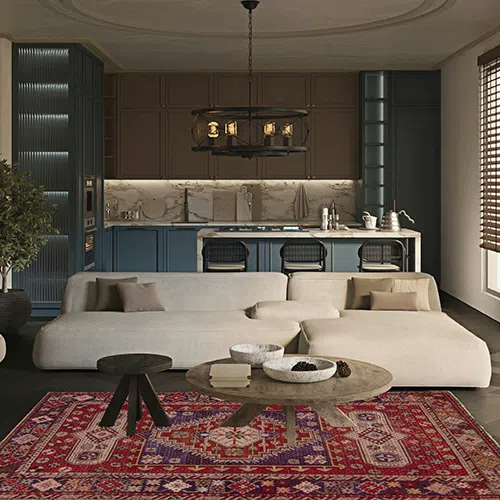
Despite their ancient roots, Kurdish rugs integrate beautifully into modern home decor. Their graphic geometries and rich palettes offer a grounded, organic counterpoint to modern furniture and clean architectural lines.
A handwoven tribal rug serves as an anchor for a room, introducing human craftsmanship, organic texture, and historical narrative into modern spaces.
Consider these styling approaches for your home:
- Minimalist Spaces: Place a vibrant Kurdish rug in a minimalist room with warm neutral walls and modern furniture. The rich colors and historic motifs create an instant focal point without cluttering the space.
- Rustic and Warm Interiors: Pair deep red and indigo Kurdish rugs with natural leather seating, exposed brick walls, and warm wood accents to accentuate their cozy, organic qualities.
- Mid-Century Modern Settings: The geometric structure of Kurdish tribal designs aligns seamlessly with mid-century furniture forms, clean wooden legs, and low-profile silhouettes.
Care and Longevity Guidelines
Because Kurdish rugs are built from durable, lanolin-rich wool, caring for them is simple. Rotate your rug 180 degrees once or twice a year to ensure even wear and light exposure. Vacuum regularly using suction only, avoiding rotating brush bars that can pull at hand-knotted pile fibers. Finally, always pair your rug with a high-quality rug pad to protect the foundation knots and prevent slipping on hardwood floors.
By bringing an authentic Kurdish rug into your home, you invest in more than beautiful floor covering—you welcome a timeless piece of nomadic history and handwoven artistry that will endure for decades to come.